Education, not investment advice. Consider the risks and discuss your circumstances with your own adviser.
- The Federal Reserve was drafted in a November 1910 meeting so secretive the attendees reportedly traveled under first names only. (Federal Reserve History)
- A dollar in 1913, the year the Fed was created, buys roughly 3–4 cents of goods today. (Minneapolis Fed CPI Calculator)
- A 2011 GAO audit found $16 trillion in emergency lending flowed out of the Fed during the financial crisis; a later academic tally put the cumulative figure at $29 trillion. (Sen. Sanders' office · Levy Economics Institute)
- As of September 2026, the Fed's balance sheet still sits near $6.75 trillion — roughly 7x its pre-2008 size — even after two years of "shrinking" it. (Federal Reserve H.4.1)
A Meeting Designed to Be Forgotten
In November 1910, a private rail car left Hoboken, New Jersey, carrying a small group of the most powerful men in American finance to a hunting retreat on Jekyll Island, Georgia. The stated purpose was a duck hunt. The actual purpose, laid out in G. Edward Griffin's influential 1994 book The Creature from Jekyll Island, was to draft the blueprint for a new American central bank.
The six documented attendees were Senator Nelson Aldrich, chair of the Senate Finance Committee and father-in-law to John D. Rockefeller Jr.; Assistant Treasury Secretary A. Piatt Andrew; Henry Davison, a senior partner at J.P. Morgan & Co.; Frank Vanderlip, president of National City Bank (today's Citigroup); Paul Warburg of the investment house Kuhn, Loeb & Co.; and Aldrich's secretary, Arthur Shelton. (Federal Reserve History)
What they produced — the "Aldrich Plan" — became, after several years of political rewriting to placate a Democratic Congress wary of Wall Street, the Federal Reserve Act of 1913. The secrecy itself is not disputed; it's recounted matter-of-factly by the Fed's own historians. The debate is over what that secrecy implies: that the men who stood to gain the most from a national banking system designed the system that would govern them.
Who Actually Owns the Federal Reserve?
Here's the detail that surprises most people: the Federal Reserve is not a conventional federal agency. It's a hybrid — a public council (the Board of Governors, appointed by the President and confirmed by the Senate) sitting atop twelve regional Federal Reserve Banks that are legally owned by the commercial banks in their district. Member banks are required to hold stock in their regional Fed and receive a statutory dividend on it.
The Fed doesn't run on congressional appropriations, its rate-setting FOMC votes require no White House sign-off, and its chair testifies to Congress but isn't hired or fired by it mid-term. That structure was intentional — designed to keep monetary policy insulated from short-term political pressure — but it's also exactly what fuels the "unaccountable" critique: an institution empowered to set the cost of money for 340 million people, financed in part by the very banks it regulates.
Born From Two Failed Experiments
The Fed wasn't America's first attempt at a central bank — it was the third.
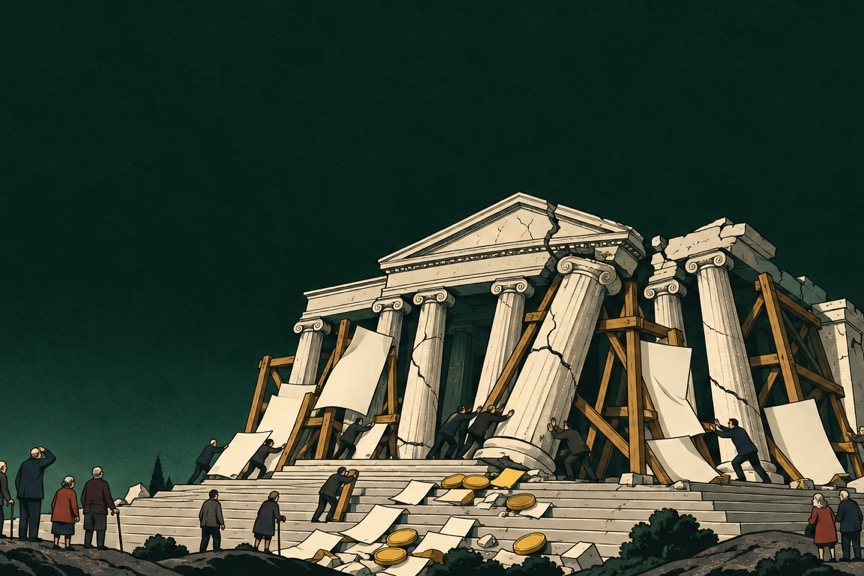
Alexander Hamilton's First Bank of the United States (1791–1811) drew immediate opposition as a vehicle for wealthy elites and was allowed to expire. The Second Bank of the United States (1816–1841) met a more violent end: President Andrew Jackson, convinced it concentrated dangerous power in private hands, vetoed its recharter and triggered the "Bank War." For the next seven decades, the U.S. ran without a central bank at all — a stretch marked by repeated bank panics, culminating in the Panic of 1907, which became the political justification for trying a third time.
Cartel or Central Bank?
Griffin and other critics argue the Fed functions less like a public institution and more like a cartel: a coordinating body that lets the largest banks manage competition, socialize their losses, and privatize their gains. It's a provocative framing, but it isn't hollow. Consider what Senator Bernie Sanders' 2011 audit amendment actually turned up when the GAO was finally allowed to look at the Fed's crisis-era books:
- $16 trillion in cumulative low- or zero-interest loans and guarantees flowed to financial institutions and corporations — American and foreign — between 2007 and 2010. (GAO-11-696) (Sanders press release)
- JPMorgan Chase alone received over $390 billion in assistance — while its CEO sat on the board of the New York Fed, one of the regional banks helping to administer the bailout.
- Roughly two-thirds of the contracts used to manage that emergency lending were awarded without competitive bidding.
- A separate, more granular study by the Levy Economics Institute at Bard College — which counted every individual loan, swap, and guarantee rather than net exposure — put the cumulative total even higher, at $29 trillion through late 2011. Former Fed Chair Ben Bernanke pushed back on that framing, arguing that peak outstanding exposure at any one time was closer to $1.5 trillion, since much of the lending was short-term and revolving. Both numbers are real; they're just measuring different things — cumulative flow versus peak balance. (Levy Institute)
Whichever figure you find more honest, the underlying fact isn't in dispute: a private-sector rescue of historic scale was carried out by an institution whose own board members had financial ties to the recipients — and it happened almost entirely outside public view until Congress forced an audit.
The Printing Era, By the Numbers
Since 2008, "quantitative easing" — the Fed buying bonds and mortgage debt with newly created reserves — has been the primary tool for propping up the economy. The scale is easy to lose track of, so here it is laid out plainly:
- QE1 (2008–2010): $1.75 trillion in Treasury, agency debt, and mortgage-backed securities purchases.
- QE2 (2010–2011): $600 billion in additional Treasury purchases.
- QE3 (2012–2014): Open-ended purchases of $40–85 billion per month until tapered.
- Result: the Fed's balance sheet grew from roughly $870 billion before the crisis to about $4.5 trillion by 2015 — a fivefold expansion in seven years. (St. Louis Fed)
- 2020–2022 (pandemic era): A fourth, larger round of QE pushed the balance sheet to nearly $9 trillion by early 2022. (Richmond Fed)
- Today: After roughly three years of "quantitative tightening," the balance sheet stands at $6.75 trillion — still about 7.8x its pre-2008 level. (Fed H.4.1, Sept. 17, 2026)
The Bill Comes Due — Who Actually Pays?
None of that money gets repaid in any conventional sense. The Fed doesn't send an invoice. Instead, the cost shows up in three places:
- Debt monetization. The Fed rolls maturing holdings into new purchases rather than shrinking its footprint to zero, keeping trillions in newly created reserves permanently in the system.
- A weaker dollar. More currency chasing the same goods erodes purchasing power over time — which is precisely what the Minneapolis Fed's own CPI data shows has happened since 1913: a dollar today buys somewhere in the neighborhood of 3–4 cents of what it bought when the Fed opened its doors, a decline north of 96%. (Minneapolis Fed)
- Higher borrowing costs later. When inflation forces the Fed's hand, it raises rates to slow the money it printed — which is exactly what happened this month.
Where We Stand, September 2026
This is the part that makes the story feel urgent rather than historical. After holding rates steady through most of 2025, the Fed just raised its benchmark rate a quarter point to a target range of 3.75%–4.00% — its first hike since 2023 — citing renewed inflation pressure, even as it was simultaneously winding down quantitative tightening. (Trading Economics) In plain terms: the Fed spent three years trying to shrink the balance sheet it built during the pandemic, and inflation came back before the job was finished — forcing a rate hike at the exact moment the printing brakes were being eased off. That's the boom-and-bust pattern critics have pointed to for a century, playing out in real time.
Seven Reasons This Should Have Your Attention
- Unelected, largely unaccountable power. Twelve people on the FOMC set the cost of money for the entire country, with no direct vote from the public.
- The power to create money from nothing. Quantitative easing isn't metaphorical — new reserves are created by entry on a ledger, not raised from savers or taxpayers.
- Boom-and-bust by design. Cheap money inflates the next bubble; tightening pops it. The 1929 crash, the dot-com bust, and 2008 all followed the same basic sequence.
- Asymmetric bailouts. Banks and corporations get emergency lending facilities; households get, at best, one-time stimulus checks.
- Interest rates as a debt lever. The Fed's rate decisions directly determine how expensive it is for the U.S. government to service a debt now well past $37 trillion.
- Global reach. Because the dollar is the world's reserve currency, Fed tightening cycles routinely trigger currency and debt crises in emerging markets that had nothing to do with the decision.
- A digital dollar on the horizon. A Fed-issued central bank digital currency would extend the institution's reach from setting the price of money to potentially tracking how every dollar is spent.
More Harm, or a Necessary Evil?
The honest verdict is not clean. The Fed has, at moments, stopped a bad recession from becoming a depression. It has also — by its own numbers — presided over a currency that has lost the overwhelming majority of its value in a single century, engineered rescue after rescue for the institutions closest to it, and built a balance sheet that still dwarfs anything imaginable before 2008. Reasonable people can look at that record and land on "necessary" or "unaccountable." What's harder to argue is that it's a small or settled question.
For most Americans, the practical takeaway isn't a policy debate in Washington — it's a decision about how to hold wealth in a system where the unit of measurement keeps shrinking. Cash sitting in a low-yield account is, by design, a depreciating asset. That's a large part of why physical precious metals — assets the Fed cannot print, dilute, or hold as a liability on its own balance sheet — have stayed relevant to investors thinking in decades rather than news cycles, particularly during the exact stretches when the Fed's balance sheet was expanding fastest.
That's the conversation American Wealth Group exists to have. Protecting Wealth. Preserving Futures. isn't a slogan we picked because it sounded good — it's the answer to a genuinely open question about what a dollar will be worth twenty years from now. If the history above raises that question for you, it's worth a conversation with an advisor before it becomes an urgent one.
Should the Fed be reformed, restrained, or left exactly as it is? History suggests the debate isn't going away — the only real choice is whether you're positioned for the answer either way.
Sources cited
- The Meeting at Jekyll Island – Federal Reserve History
- Senator Bernie Sanders — "The Fed Audit" press release
- GAO-11-696, Federal Reserve System audit
- Forbes — "The Fed's $16 Trillion Bailouts Under-Reported"
- Levy Economics Institute — "$29,000,000,000,000: A Detailed Look at the Fed's Bailout"
- St. Louis Fed — "The Rise and (Eventual) Fall in the Fed's Balance Sheet"
- Richmond Fed — Econ Focus Q3 2022
- Federal Reserve H.4.1 release, Sept. 17, 2026
- Trading Economics — U.S. Fed Funds Rate
- Minneapolis Fed — CPI/Inflation Calculator, 1913–present
- G. Edward Griffin, The Creature from Jekyll Island (1994) — source of the "cartel" framing referenced throughout
Want to Talk About What This Means for Your Savings?
If the history of the Federal Reserve has you thinking about the purchasing power of your own savings, our free guide walks through diversification, rollovers, custody and costs. Or reach out and we will talk it through with you.